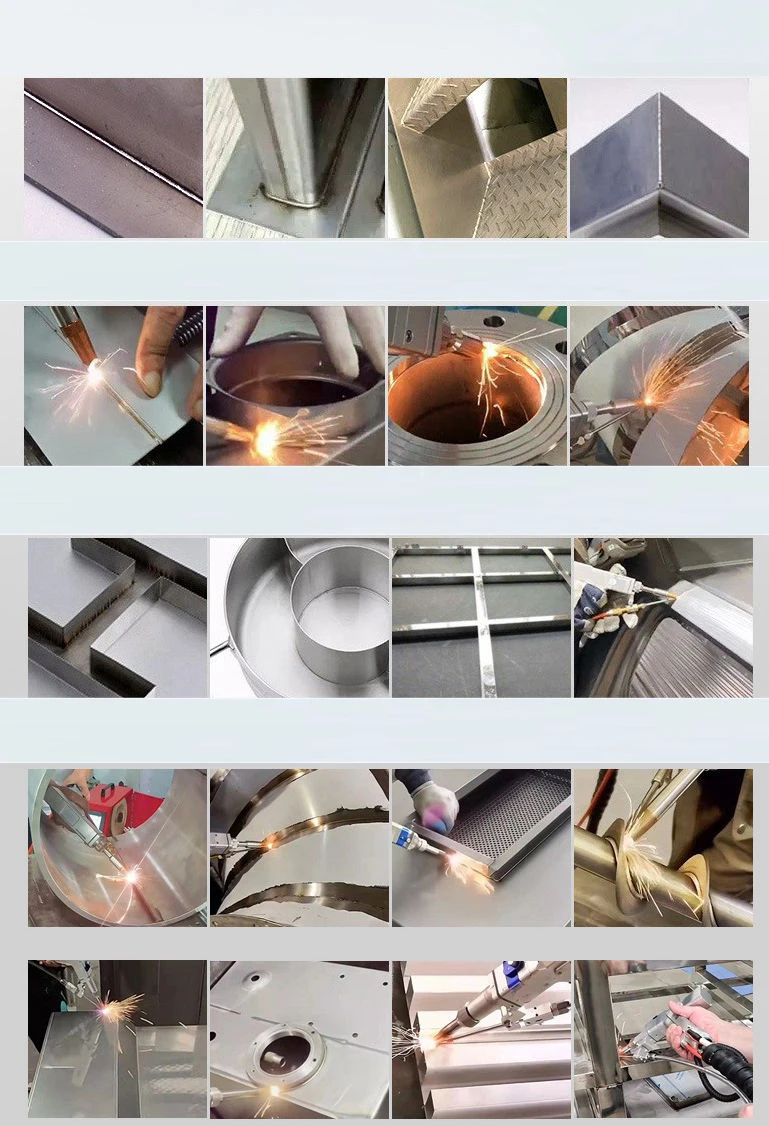
Compared with traditional welding, low-power pulse laser seam welding has advantages such as high power density, energy convergence, small heat input, narrow weld seam, and small deformation. Moreover, after laser beam aggregation, small light spots can be obtained, enabling precise positioning. These characteristics make laser seam welding more suitable for welding small-scale workpieces than other welding methods.
For laser welding of ultra-thin stainless steel materials, because the materials are very thin, it is very simple to vaporize and puncture, so we want to get a continuous weld without burn through. The key is to accurately manipulate the parameters.
The primary parameters that affect the quality of laser welding are welding current, pulse width, pulse frequency, etc. The factors that should be paid attention to are as follows.
1.As the current increases, the width of the weld seam increases, and the welding process gradually presents splashing. The surface of the weld seam presents an oxidized appearance and a rough feeling.
2.As the pulse width increases, the width of the weld also increases. The effect of pulse width on laser welding of stainless steel ultra-thin plate is very obvious. A small increase in pulse width can cause oxidation and burning through of the sample.
3.As the pulse frequency increases, the stacking rate of solder joints increases, and the weld width first increases, then remains unchanged. Under a microscope, the welds are becoming more and more lubricated and beautiful. But when the pulse frequency is added to a certain value, the welding process splatters severely, the weld seam becomes rough, and the upper and lower surfaces of the welded part show an oxidation appearance.
4.Positive defocusing is suitable for laser welding of ultra-thin plate data. Under the same defocusing amount, the weld appearance obtained by positive defocusing Laser beam welding is more lubricated and beautiful than that obtained by negative defocusing.