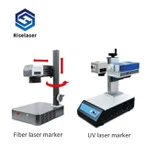
UV laser marking machine, when the laser acts on the glass for processing, etching and marking process, it needs a high energy density, but if the energy density is too high, there will be cracks or even edge collapse. If the energy density is too low, the hit points will sink or cannot be etched directly on the surface, so it is difficult to process.
UV laser marking machine marks on flat glass, which is directly related to the peak power of laser, the size of focusing spot and the speed of galvanometer. Sometimes the light of high-power laser will pass through directly without etching on the glass surface. This is because the peak power of the laser is not enough or the energy density is not concentrated enough.
The peak power is affected by the laser crystal, pulse width and frequency. The narrower the pulse width, the lower the frequency, and the higher the peak power of the laser. We only need to change the scanning speed of the galvanometer to an appropriate value to get a better machining effect. However, it should be noted that the scanning speed is also affected by the frequency of the laser itself. If the frequency is too low, it will also lead to leakage.
When marking on curved glass, the UV laser is affected by the curved surface. The focal depth of the focused spot and the scanning mode of the galvanometer are particularly important to the processing effect, that is, they are affected by the peak power of the laser, the focused spot, the scanning speed of the galvanometer, the scanning mode of the galvanometer, the focal depth of the spot and the range of the field mirror. When the energy density reaches the standard, we will find that the effect is worse as the glass surface moves towards the edge, and even cannot process on the surface. The reason is that the focal depth is too shallow.

Therefore, the process of processing glass by UV laser marking machine is analyzed. For curved glass with large amplitude and high hardness, the laser with high UV beam quality, power and narrow pulse width should be selected, which is more suitable for processing such parts than the laser and galvanometer independently developed by the laser.