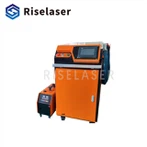
The order demand for hand-held laser welding machines is very strong. Customers are excited about the easy operation of our handheld laser welding machine, the improvement of welding quality, and the diversity of connectable materials. In some applications, handheld laser welding machines can help customers reduce the material cost of manufacturing components because they can use metals that cannot be welded by traditional processes. In addition, the handheld laser welding machine can also clean the surface before and after welding, further reducing costs and improving productivity. In addition, this product can also help solve the problem of shortage of qualified welders and high labor costs, because the training process of handheld laser welding machine only takes a few hours, and even non professional welders can easily use it.

At present, the application fields of handheld laser welding are mainly concentrated in the welding processes that are complex and irregular and do not require clamps, such as sheet metal, chassis, water tank, distribution box and other cabinets, kitchen and bathroom cabinets, stainless steel door and window guardrails, etc. Compared with traditional argon arc welding and electric welding processes, handheld laser welding has obvious advantages in terms of energy saving (about 80%~90% less than argon arc welding), welding speed, welding quality, and subsequent treatment (which can greatly reduce the labor cost of polishing and leveling processes) of thin stainless steel plates, iron plates, aluminum plates and other metal materials. Therefore, it has a strong potential to replace traditional processes.

At the same time, handheld laser welding itself is also constantly undergoing technology and process iteration. In the past, the handheld laser welding used ordinary straight head welding, and the weld seam was narrow, which restricted the processing ability of laser welding to a certain extent. In order to solve this problem, many manufacturers have reformed the welding joint and developed the swing welding joint and swing welding process. Swing welding can adjust the welding spot from 0.2 mm to 6 mm (it can be adjusted as required), breaking the restriction of large weld requirements on welding ability, and thus achieving the same penetration at the same welding speed when reducing the laser power, or obtaining different weld widths by changing the parameters of vibration welding.