

The protective lenses on a laser welding machine's welding head serve several purposes. They include protective lenses, focusing lenses, and collimating lenses, which safeguard sensitive components of the welding head from splashes, debris, and intense heat generated during welding. This helps extend the equipment's lifespan.
How to identify if the protective lenses are damaged? When protective lenses are damaged, how can you quickly confirm their condition?
Two common indicators of damage are:
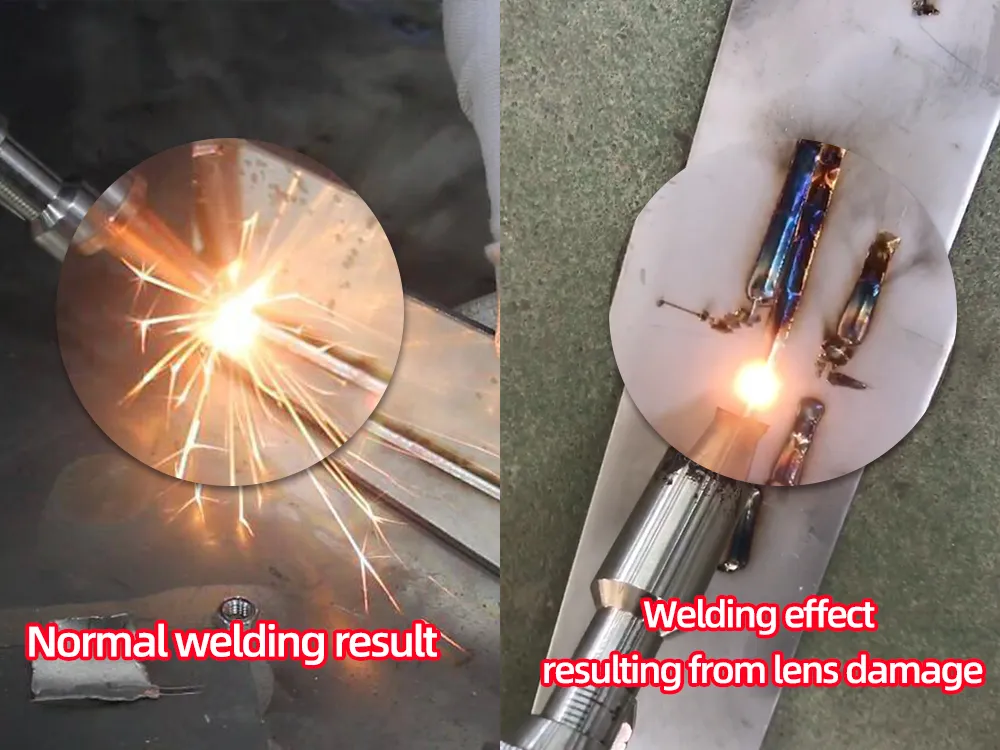
- Initially, the laser typically operates upon startup but gradually weakens until it cannot melt welding wire.
- There is a noticeable flame at the welding copper nozzle.
Comparison between normal welding results and those caused by lens damage: Upon encountering these issues, it's likely the protective lenses inside the welding gun are damaged.
Despite this, it remains to determine which group of protective lenses is faulty: the protective lenses themselves, focusing lenses, collimating lenses, reflecting lenses, or any combination thereof. When a fault occurs, the above symptoms manifest. The sequence for checking lenses involves first replacing the protective lenses, followed by inspecting the focusing lenses, and subsequently examining the reflecting and collimating lenses, replacing them as per findings.
A notable flame at the welding copper nozzle is often indicative of a focus issue.
Lastly, inspect the laser QBH connector for contamination or damage.
Is it necessary to replace the protective lenses? Consider the condition of the protective lenses:
- Clear black spots on protective lenses are likely slag or indicate overdue replacement.
- Anomalies across all lenses, caused by the laser's sharp Gaussian beam, result in white spots.
- Abnormal oscillations or the red light's positioning due to interference burn the seals together.
- Contaminants usually cause damage to the convex surface of automated welding head lenses, showing black spots.
- Damage to the flat surface of automated welding head lenses results from laser diffuse reflection, indicating white spots.
How to prevent protective lens damage? To avoid damaging protective lenses, adhere to these guidelines:
- Use original protective lenses.
- During lens replacement, take care to prevent contamination.
- Avoid positioning the welding gun vertically to the welding object, especially when welding highly reflective metals.
- Promptly replace damaged lenses.
- Ensure proper grounding by securely attaching the machine's grounding wire.
By following these practices, you can effectively maintain the integrity and functionality of protective lenses in laser welding applications.


